

Bridges are one of the most important structures to engineering today. They are one of the most used structures by people due to their facilitation of travel. Bridges help carry cars over rivers or gaps that would normally be uncrossable. But how are they able to carry so many heavy vehicles without collapsing?
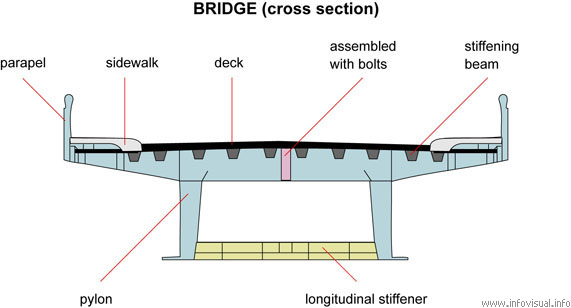
The Beam Bridge is a classic design of a bridge that is still used today. A horizontal deck with beams lining each side is supported by columns. It is able to support cars by utilizing slight bending to distribute the forces. They are made of structural steel, reinforced concrete, and prestressed concrete. These materials all have a high tensile and high compressions strength, allowing the bridge to stay strong under the constant pressure of its weight and the weight of the cars above it. It’s a simple design that is effective for crossing short gaps easily and are relatively cheap. Some famous beam bridges include the San Mateo-Hayward Bridge in California, the Lake Pontchartrain Causeway in Louisiana, and the Tianjin Grand Bridge in Tianjin, China. These bridges all span tens of miles across large bodies of water supported by horizontal beams that provide tensile strength and columns that hold the bridge up.
Engineers often choose beam bridges over other bridge designs because they are simple, cost effective, and practical for the short spans. Beam bridges only comprise of vertical columns and horizontal beams, making them the simplest bridge design that is effective and stable. Because of their simple structure, they also don’t require expensive supports or cables that make labor easier and building cost cheaper. Construction is fast, making them highly practical when building bridges over shorter spans with high traffic. Beam bridges, while an old design, remains a strong bridge design that continues to carry people every day to where they need to go.

Leave a Reply