

• Home
  • Engineering Portfolio
  • Research & Publications
  • Music & Leadership
    • Who we are
      • About Us
      • What We Do
      • My Performances
    • Why Music Matters
      • Music & Engineering
      • Music & Success
      • Music & Stress
    • Get Started
      • Find Tutors
      • Find Instruments
      • Find Music
      • Find Scholarships
    • FAQ
      • Student FAQ
      • Teacher FAQ
      • Donate
  • My Blog/ Engineering Journal
  • About Me
    • My Profile
    • My Publications
    • My Performances
    • My Blog
PranavAirPranavAir
PranavAirPranavAir
  • Home
  • Engineering Portfolio
  • Research & Publications
  • Music & Leadership
    • Who we are
      • About Us
      • What We Do
      • My Performances
    • Why Music Matters
      • Music & Engineering
      • Music & Success
      • Music & Stress
    • Get Started
      • Find Tutors
      • Find Instruments
      • Find Music
      • Find Scholarships
    • FAQ
      • Student FAQ
      • Teacher FAQ
      • Donate
  • My Blog/ Engineering Journal
  • About Me
    • My Profile
    • My Publications
    • My Performances
    • My Blog

How Engineers Choose between Reinforced Concrete and Structural Steel

Home » Blog – Grid » How Engineers Choose between Reinforced Concrete and Structural Steel
How Engineers Choose between Reinforced Concrete and Structural Steel
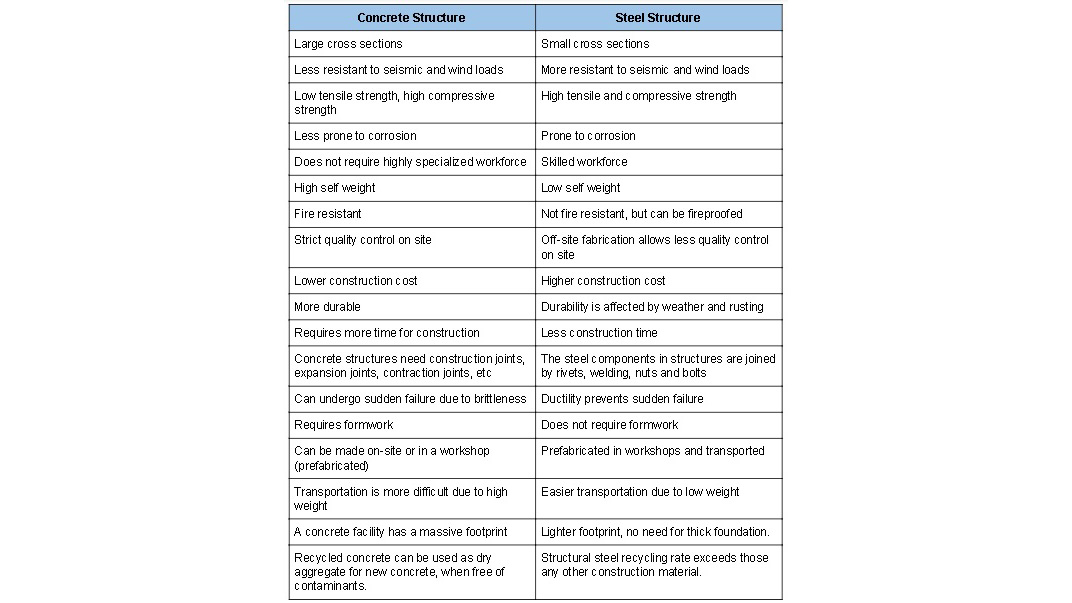
Concrete Vs Steel Structure Comparison [CLICK TO ENLARGE]

How Engineers Choose between Reinforced Concrete and Structural Steel

March 17, 2026 Posted by Pranav Srivatsan My Blogs, Structural Engineering

Some buildings rely heavily on reinforced concrete for stability, while others use structural steel. I first noticed this when I was researching on the different types of materials commonly used in skyscrapers. I wondered why engineers must choose carefully between the two if they are both strong materials. The key lies in the type of forces the planned building would potentially face. 

Both reinforced concrete and structural steel are widely used in construction. However, each one has a specific advantage over the other. Concrete is extremely strong against compression, but weaker in tension. While structural steel is strong in both tension and compression, reinforced concrete also provides the added benefit of natural fire resistance and sound insulation. Reinforced concrete is also less expensive than steel, so it can be safely used in smaller projects where extreme strength is not necessary.

The choice between reinforced concrete and structural steel depends on what challenges the planned building is likely going to face. Skyscrapers usually face high wind forces that push laterally on the building. In this scenario, the high tension strength of structural steel provides a safer structure than concrete. Construction that needs to be done in a smaller timespan also tends to favor steel since concrete needs several days to harden completely. However, in places susceptible to fire such as chemical labs, concrete is preferred due to its natural resistance to fire and weather. Overall, both steel and concrete have advantages and disadvantages depending on the type of forces and weathering that the building may experience. The choice between reinforced concrete and structural steel often depends on the location of and weather surrounding the building. Selecting the right material for the project is vital to keep buildings safe and strong. It is important to understand that there is no universal best building material, and that different materials need to be selected based on the context of the building. The research I conducted on different building materials and how they support structures helped me understand that selecting the right materials is one of the most important parts of creating structures that are safe and strong.

0

About Pranav Srivatsan

I am a high school student at Mission San Jose High School in Fremont, California, with a passion for civil and structural engineering. My long-term goal is to design resilient buildings, bridges, and infrastructure that improve the way people live and connect. My interest in engineering extends well beyond the classroom. I actively seek opportunities to learn through internships, construction site visits, technical drawings, field observations, and conversations with practicing engineers. Every project helps me better understand how engineering concepts are applied to solve real-world challenges. To document my learning journey, I created www.pranavair.com, where I maintain an Engineering Journal and Engineering Notebook. Through articles, site visits, and project documentation, I explore topics ranging from structural engineering and bridge design to transportation systems, geotechnical engineering, flood control, and water resources. My goal is to share what I'm learning and encourage other students to look more closely at the remarkable engineering that surrounds us. I enjoy using CAD software, studying construction drawings, observing infrastructure projects, and asking questions about how things work. I believe the best way to learn engineering is by combining classroom knowledge with hands-on experience and continuous curiosity. As I prepare for college, I'm seeking opportunities to learn from engineers, contribute to meaningful projects, and continue growing toward a career in structural engineering. I'm always happy to connect with students, educators, and professionals who share an interest in civil engineering, infrastructure, and lifelong learning.

You also might be interested in

Why Skyscrapers Sway in the Wind

Why Skyscrapers Sway in the Wind

Mar 1, 2026

Growing up in the bay area, I was always one[...]

Uncovering a Hidden Microclimate

Uncovering a Hidden Microclimate

Jan 18, 2026

Weather forecasts are supposed to tell us what to expect,[...]

How Structural Engineers Account for Building Loads

Jun 28, 2026

During my summer internship, I noticed how one or two[...]

Most Commented Posts

  • Uncovering a Hidden Microclimate By Pranav Srivatsan on January 18, 2026 0
  • The Strangely Warm Winter Week By Pranav Srivatsan on February 25, 2026 0
  • Why Skyscrapers Sway in the Wind By Pranav Srivatsan on March 1, 2026 0

Recent Comments

Most Liked Posts

  • The Strangely Warm Winter Week By Pranav Srivatsan on February 25, 2026 3
  • Uncovering a Hidden Microclimate By Pranav Srivatsan on January 18, 2026 1
  • Why Skyscrapers Sway in the Wind By Pranav Srivatsan on March 1, 2026 0

Find us on

Contact Me

Like what you see or have questions? Drop me a note.

Send Message

© 2026 — PranavAir. All rights reserved.

  • Home
  • About
  • Privacy Policy
Prev Next